Try “geodes”, “Oregon”, “gold panning” or a town name.

Where to find ammonites

We have not verified a public or pay to dig place for ammonites yet. Marine rocks from Devonian to Cretaceous age. In the U.S. they are most common in Cretaceous shales and chalks of the Western Interior, such as the Cretaceous rocks of central and western Kansas; smaller Paleozoic forms turn up in Pennsylvanian and Permian rocks.
Where ammonites occur in the U.S.

Extinct shelled relatives of squid and the chambered nautilus. Most had flat-coiled, chambered shells; some, such as Baculites, were straight.

Marine rocks from Devonian to Cretaceous age. In the U.S. they are most common in Cretaceous shales and chalks of the Western Interior, such as the Cretaceous rocks of central and western Kansas; smaller Paleozoic forms turn up in Pennsylvanian and Permian rocks.

Host rock: Marine shale, chalk and limestone, often inside concretions.

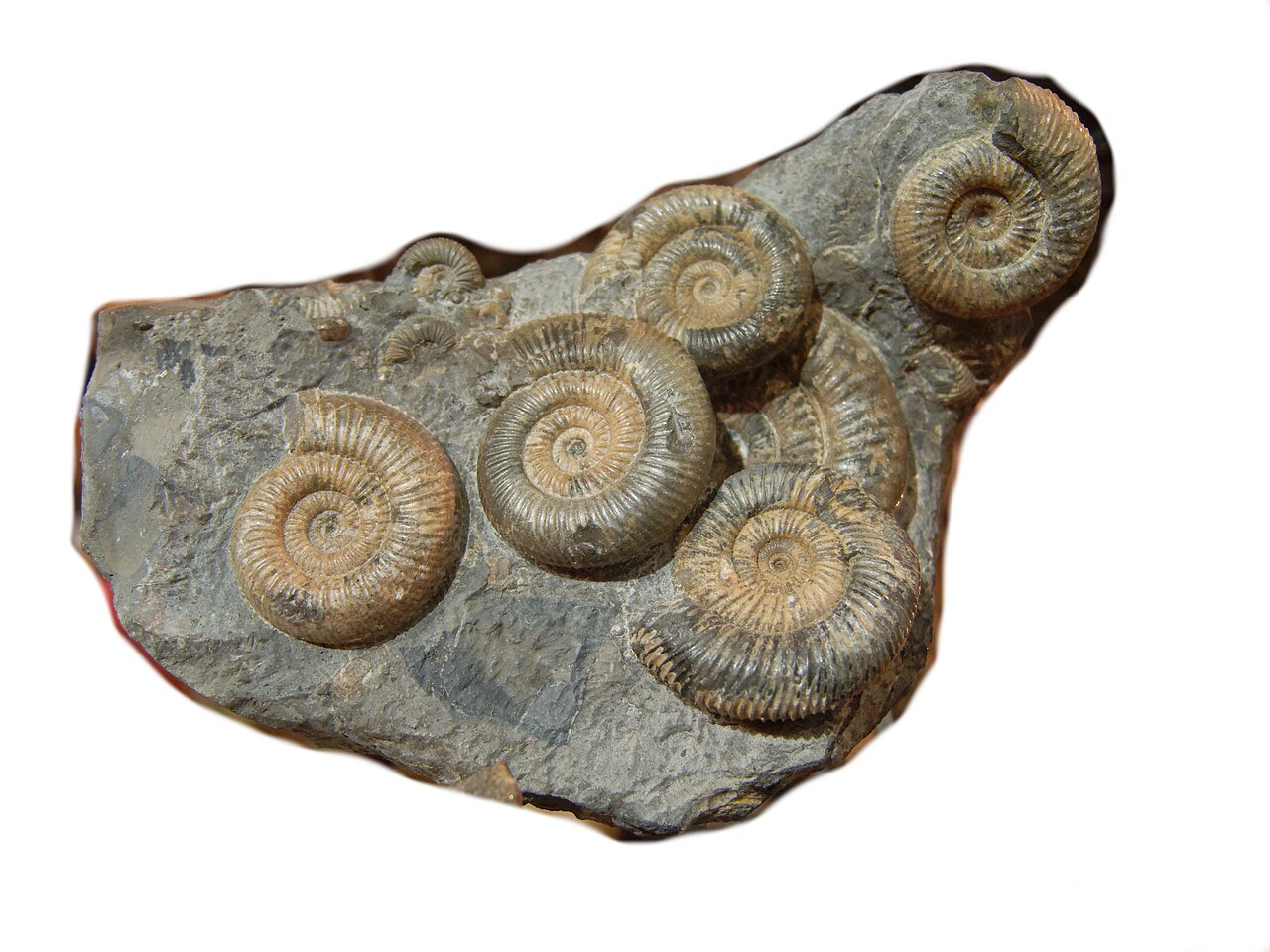
Several ribbed, coiled ammonite fossils on a slab of gray rock.
Ammonite fossils on a slab of rock. Photo: Thomas Bresson, CC BY 3.0, via commons.wikimedia.org

How to recognize ammonites in the field

  • Coiled shell in one plane, like a flat spiral.
  • Wavy or frilly suture lines where the internal chamber walls met the shell, visible where the outer shell is worn off.
  • Ribs, nodes or spines on many species.
  • Straight forms (Baculites) look like segmented rods with the same wavy sutures.

Look-alikes

  • Snails (gastropods): coil upward in a spiral cone, not flat, and have no chambers.
  • Nautiloids: chambered, but with simple, smoothly curved sutures.
  • Coiled concretions or worm tubes: no chambers or sutures.

Where to look

  • Check concretions weathering out of dark marine shale; ammonites are often inside them.
  • Look on eroding shale slopes after rain for shell fragments with suture patterns.

Collecting rules for ammonites

  • Ammonites are invertebrates: casual collecting rules apply on BLM land (up to 25 pounds per person per day) and National Forest land (25 pounds per day, 100 pounds per year).
  • No collecting on National Park Service land; get permission on private land.

Details: BLM rockhounding rules, national forest rules, mining claims.

Sources

  1. Ammonoids are cephalopods, relatives of squid, octopus and the chambered nautilus. geokansas.ku.edu, checked November 19, 2026.
  2. Ammonoids appeared in the Devonian and died out about 66 million years ago at the end of the Cretaceous. geokansas.ku.edu, checked November 19, 2026.
  3. Ammonoids are fairly common in the Cretaceous rocks of western Kansas. geokansas.ku.edu, checked November 19, 2026.
  4. Most ammonoids coiled in one plane; others were straight or irregularly coiled. geokansas.ku.edu, checked November 19, 2026.
  5. Utah Geological Survey counts ammonites among invertebrate fossils. geology.utah.gov, checked November 19, 2026.
  6. Under the BLM casual collecting rule, a reasonable amount is at most 25 pounds of common invertebrate or plant fossils per person per day. govinfo.gov, checked November 19, 2026.
  7. On National Forest System land, casual collecting of common invertebrate and plant fossils is limited to 25 pounds per day and 100 pounds per calendar year. govinfo.gov, checked November 19, 2026.