Try “geodes”, “Oregon”, “gold panning” or a town name.

Where to find chalcedony

Chalcedony turns up at two verified places in one state: California. Two are on public land where collecting is allowed. We last checked them on November 20, 2026.

Loading the map.

Public land Fee dig Permission needed Public land spot, not field-checked BLMNational forestState landNational park (no collecting)

Where chalcedony occur in the U.S.

Microcrystalline quartz that forms crusts, nodules and fillings in rock cavities. Agate and jasper are both forms of it; collectors use the plain name for unbanded, translucent material such as chalcedony roses.

Widespread in the West wherever silica-rich water moved through volcanic or sedimentary rock: central Oregon, southern Utah, Arizona and the desert of southeastern California, where chalcedony roses weather out onto the ground.

Host rock: Cavities, veins and crusts in volcanic rock and in sandstone and mudstone; loose on desert pavement and in washes.
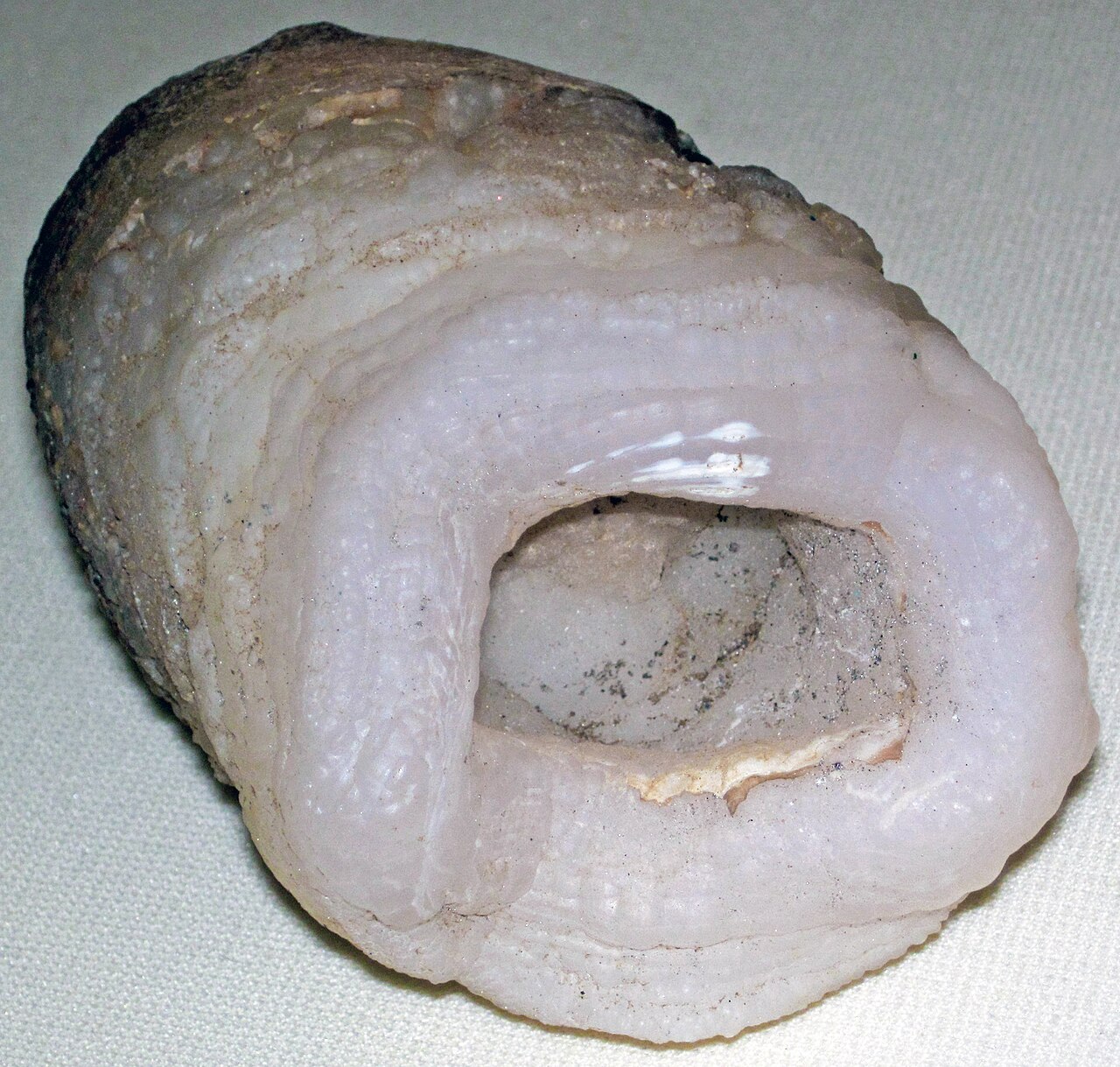
A pale lavender chalcedony tube with a bumpy, layered surface.
Chalcedony from Round Mountain, Arizona. Photo: James St. John, CC BY 2.0, via commons.wikimedia.org

Best verified places by state

On public land, not field-checked

USGS and Smithsonian records place chalcedony at 14 more spots on BLM or national forest land with no active mining claim at the point. We have not visited them; each one lists its land unit, nearby claims and the source record.

How to recognize chalcedony in the field

  • Waxy luster and translucent edges.
  • Hardness about 7: scratches glass.
  • Often white, gray, bluish or tan, with a smooth, bubbly or rose-like surface.
  • Breaks with smooth, curved fractures and no cleavage.

Look-alikes

  • Calcite crusts: much softer (a knife scratches them) and fizz in dilute acid.
  • Gypsum desert roses: very soft (a fingernail scratches them) and form bladed crystals rather than a waxy crust.
  • Opal: softer and often shows a glassier or more porcelain-like surface.

Where to look

  • Scan desert pavement and washes in low sun; the waxy surfaces reflect light.
  • Chalcedony roses often lie loose on the surface, so start by walking slowly before digging.

Collecting rules for chalcedony

  • On BLM land, reasonable amounts for personal, noncommercial use can usually be collected without a permit.
  • Around Glass Buttes, Oregon, mining claims may not be filed for chalcedony (agate) or obsidian.

Details: BLM rockhounding rules, national forest rules, mining claims.

All verified places for chalcedony

  1. Public land

    Savahia Peak Rock Collecting Area

    Vidal Junction, California Bureau of Land Management

    Chalcedony

    Checked November 20, 2026

  2. Public land

    Wiley Well District Geode Beds

    Blythe, California Bureau of Land Management

    Geodes, Agate, Chalcedony, Jasper

    Checked November 19, 2026

Sources

  1. Central Oregon volcanic rocks contain several kinds of chalcedony, including agate and jasper. fs.usda.gov, checked November 19, 2026.
  2. Rockhounds find chalcedony roses in eastern Imperial County, California. blm.gov, checked November 19, 2026.
  3. Agate, chert and jasper are microcrystalline quartz with a waxy or dull luster that forms when groundwater fills fractures and cavities. geology.utah.gov, checked November 19, 2026.
  4. Agate is the banded form of chalcedony and jasper the mottled, colored form. oregon.gov, checked November 19, 2026.
  5. Mining claims may not be filed for obsidian or chalcedony (agate) around Glass Buttes. fs.usda.gov, checked November 19, 2026.
  6. On BLM land the public may generally collect reasonable amounts of rocks and mineral specimens for noncommercial use without a permit, except in places such as developed recreation sites and active mining claims. blm.gov, checked November 19, 2026.