Try “geodes”, “Oregon”, “gold panning” or a town name.

Where to find pyrite

Pyrite turns up at eight verified places in five states, most of them in Alaska and Maine. Three are on public land where collecting is allowed. We last checked them on November 19, 2026.

Loading the map.

Public land Fee dig Permission needed BLMNational forestState landNational park (no collecting)

Where pyrite occur in the U.S.

Pyrite is iron sulfide, the brassy "fool's gold" that often grows as striated cubes. It shows up in almost every kind of rock.

Widespread. Well known in the lead-zinc district of the Upper Mississippi Valley along the Minnesota, Iowa and Wisconsin borders, and in sulfide deposits of northern Wisconsin and Minnesota.

Host rock: Hydrothermal veins, sulfide deposits, shale and other fine-grained sedimentary rock (where it forms concretions and "pyrite dollars"), limestone, and igneous and metamorphic rock.
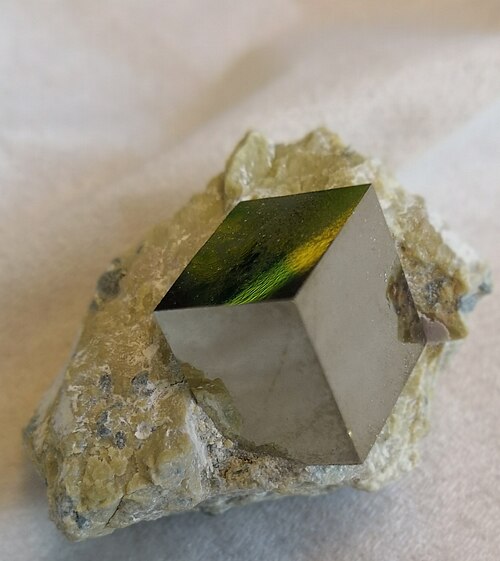
A shiny metallic pyrite cube set in pale rock.
A cubic pyrite crystal in matrix from the Victoria Mine, Navajún, Spain. Photo: DrHughManning, CC BY-SA 4.0, via commons.wikimedia.org

Best verified places by state

How to recognize pyrite in the field

  • Pale brassy yellow with a metallic luster; tarnishes darker and sometimes iridescent.
  • Hardness 6 to 6.5: it scratches glass and a knife does not mark it. Brittle.
  • Greenish black to brownish black streak.
  • Heavy for its size (specific gravity about 5).
  • Cubes and octahedrons, often with fine parallel lines (striations) on the faces.

Look-alikes

  • Gold: soft and malleable, never in cubes, with a yellow streak.
  • Chalcopyrite: softer, a deeper greenish yellow, and tarnishes to blue and purple.
  • Marcasite: same composition, but grows in radiating, fibrous or cockscomb forms.

Where to look

  • A rusty limonite stain on rock often marks weathered pyrite underneath.
  • Store specimens dry. Pyrite oxidizes, and some specimens crumble in damp air.

Collecting rules for pyrite

The general rules for the land apply. On BLM land you can take reasonable amounts for personal use; national parks allow no collecting; private land and mining claims need the owner’s permission.

Details: BLM rockhounding rules, national forest rules, mining claims.

All verified places for pyrite

Filter 8 places
Access
  1. Public land

    Bertha Creek Gold Panning Area

    Girdwood, Alaska USDA Forest Service

    Gold, Pyrite, Quartz crystals

    Checked November 19, 2026

  2. Public land Free

    Deer Hill Mineral Collecting Area

    Stow, Maine USDA Forest Service

    Amethyst, Quartz crystals, Feldspar and moonstone, Aquamarine and beryl, Garnet, Pyrite, and 1 more

    Checked November 19, 2026

  3. Public land

    Sixmile Creek Gold Panning Area

    Hope, Alaska USDA Forest Service

    Gold, Pyrite, Quartz crystals

    Checked November 19, 2026

  4. Fee dig Non-campers $16 ages 12 and up, $10 ages 6 to 11; campers $14 and $8; 5 and under free. Tool rentals $3 to $7.

    Crystal Grove Diamond Mine and Campground

    St. Johnsville, New York Private

    Herkimer diamonds, Quartz crystals, Calcite, Pyrite

    Checked November 19, 2026

  5. Fee dig Buckets of mine material from $25 to $100 or more.

    Dig Maine Gems

    West Paris, Maine Private

    Aquamarine and beryl, Garnet, Mica, Pyrite, Quartz crystals, Tourmaline

    Checked November 19, 2026

  6. Fee dig $25 ages 13 and up, $5 ages 5 to 12, free 4 and under; tool rental $25 per day plus deposit

    Emerald Village McKinney Mine Dumps

    Little Switzerland, North Carolina Private

    Mica, Quartz crystals, Feldspar and moonstone, Garnet, Aquamarine and beryl, Opal, and 2 more

    Checked November 19, 2026

  7. Fee dig $30 per person, children 5 and under free; includes equipment, one bag of pay dirt, museum entry and a panning lesson. Larger pay dirt bags $60 to $1,000.

    Gold Daughters

    Fairbanks, Alaska Private

    Gold, Pyrite, Quartz crystals, Garnet, Fossils

    Checked November 19, 2026

  8. Fee dig $10 vehicle day use. Panning lessons $12 per person.

    Marshall Gold Discovery State Historic Park

    Coloma, California State park

    Gold, Garnet, Pyrite

    Checked November 19, 2026

Sources

  1. Pyrite has a hardness of 6 to 6.5 and is brittle. commonminerals.esci.umn.edu, checked November 19, 2026.
  2. Pyrite leaves a greenish black or brownish black streak. commonminerals.esci.umn.edu, checked November 19, 2026.
  3. Pyrite has a specific gravity of 5 or more. commonminerals.esci.umn.edu, checked November 19, 2026.
  4. Pyrite is much harder than gold and often has flat crystal faces gold lacks. commonminerals.esci.umn.edu, checked November 19, 2026.
  5. Pyrite forms cubes or octahedrons, while marcasite is radiating and fibrous. commonminerals.esci.umn.edu, checked November 19, 2026.
  6. Pyrite oxidizes and alters to limonite. commonminerals.esci.umn.edu, checked November 19, 2026.
  7. Pyrite is common along the Minnesota, Iowa and Wisconsin borders in the Upper Mississippi Valley lead-zinc district. commonminerals.esci.umn.edu, checked November 19, 2026.