Try “geodes”, “Oregon”, “gold panning” or a town name.

Where to find turquoise

We have not verified a public or pay to dig place for turquoise yet. Arizona, Nevada, New Mexico, Colorado and California, near copper deposits in dry country. Nevada has had 75 to 100 productive mines and prospects.

No mapped points here. Places that need permission are listed without coordinates.

Public land Fee dig Permission needed Public land spot, not field-checked BLMNational forestState landNational park (no collecting)

Where turquoise occur in the U.S.

Turquoise is a hydrated copper aluminum phosphate prized for its blue to green color. The United States is the world's largest producer.

Arizona, Nevada, New Mexico, Colorado and California, near copper deposits in dry country. Nevada has had 75 to 100 productive mines and prospects.

Host rock: Veins, seams and nodules in altered rock near copper deposits, where groundwater moved through aluminum-rich rock carrying copper.
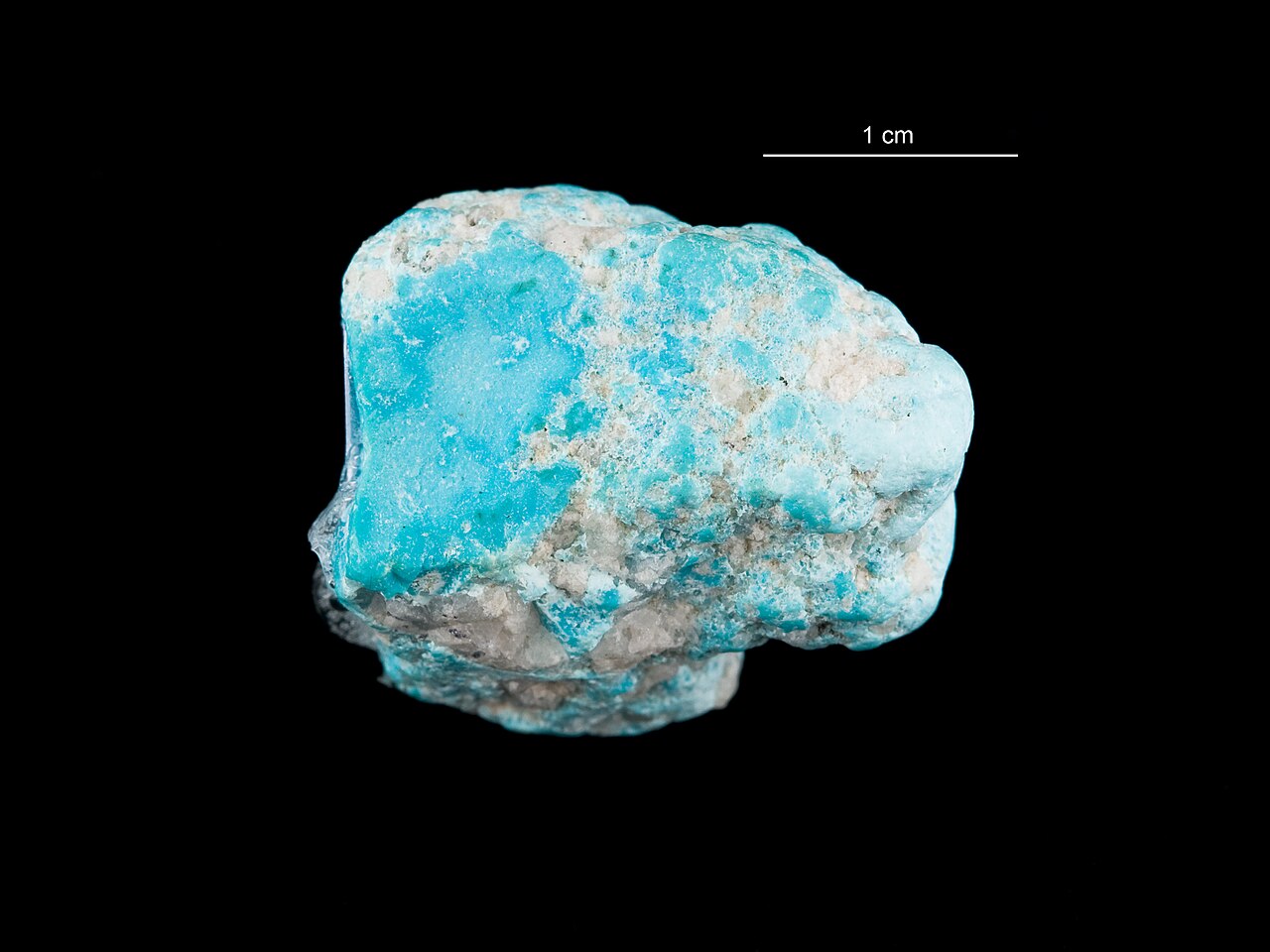
A rough blue turquoise nugget with pale matrix on a black background.
Turquoise from Bisbee, Arizona. Photo: Kaarel Tiidus, CC BY-SA 4.0, via commons.wikimedia.org

On public land, not field-checked

USGS and Smithsonian records place turquoise at 4 more spots on BLM or national forest land with no active mining claim at the point. We have not visited them; each one lists its land unit, nearby claims and the source record.

How to recognize turquoise in the field

  • Opaque sky blue to green, often with brown or black matrix lines (spiderweb).
  • Hardness about 6 for good material; chalky, porous turquoise is much softer.
  • Waxy to dull luster; specific gravity about 2.6 to 2.8.
  • Forms veins, crusts and nodules, not visible crystals.

Look-alikes

  • Chrysocolla: softer (2 to 4) and often brighter blue-green.
  • Dyed howlite or magnesite: look for white showing in cracks, scratches or drill holes.
  • Stabilized or reconstituted turquoise: porous material impregnated with resin, common in the trade.

Where to look

  • Look around copper mines and prospects in arid ground. Much Arizona turquoise is a byproduct of copper mining.
  • Most turquoise ground is active mine property or claimed; ask before collecting.

Collecting rules for turquoise

The general rules for the land apply. On BLM land you can take reasonable amounts for personal use; national parks allow no collecting; private land and mining claims need the owner’s permission.

Details: BLM rockhounding rules, national forest rules, mining claims.

Sources

  1. Turquoise forms where groundwater percolates through aluminous rock in the presence of copper, usually near copper deposits in arid regions. apps.usgs.gov, checked November 19, 2026.
  2. The United States is the largest producer of turquoise. apps.usgs.gov, checked November 19, 2026.
  3. Arizona turquoise is mined as a byproduct from several copper mines. apps.usgs.gov, checked November 19, 2026.
  4. Nevada has had 75 to 100 mines and prospects with sizable turquoise production. apps.usgs.gov, checked November 19, 2026.
  5. Stabilized and reconstituted turquoise is porous material pressure-impregnated with acrylic resin. apps.usgs.gov, checked November 19, 2026.
  6. Turquoise has a hardness of about 6 and a specific gravity of 2.60 to 2.83, and is confused with chrysocolla and dyed howlite. pubs.usgs.gov, checked November 19, 2026.
  7. Chrysocolla has a hardness of 2 to 4. pubs.usgs.gov, checked November 19, 2026.